EMT Practice Test

1. Question Content...


Question List

Question1: An initial match specification is built and executed- The match executes slower than expected and it is suspected that blocking may be a factor.
Which option would be effective in determining if the block sizes are too large?

Question2: Which statement would NOT be a purpose for the matching process?

Question3: Which match type would you use to perform a "fuzzy" match for a field containing many un-parsed words (such as a comments field)?

Question4: Which statement describe the benefits of parsing data?

Question5: A match pass is running a very long time. What is the most common first thing you should review?

Question6: What pattern would search from the end of the string to find a pattern that ends with a number?

Question7: Which statement is true about creating a Match Statistics report from a One-source match?

Question8: How can Word Investigation reports be used to modify a rule set?

Question9: A match review was just completed and determined that individuals with different middle names are being grouped together.
Which option would be effective in breaking these two individuals apart?

Question10: You re-ran a job to update the standardized data. This standardized data file is used in your test environment configuration on Match Designer.
What action would you take to insure the most current standardized data file is used?

Question11: When reviewing the results of a Match job you notice that some records are not included in a match group.
Which option would you review to determine why the records are not matching?

Question12: Which statement is true regarding Quality Stage data survivorship?

Question13: Which data element is required for Address Verification (AVI)?

Question14: Which statement about the jobs used by the Match Specification Setup Wizard is true?

Question15: Once changes are introduced in a Rules Set, which option confirms the new rules set works properly with your data?

Question16: Based on the following complex survivorship rule:
SIZEOF(b.FirstName) < SIZEOF(c.FirstName)
Which statement is correct?

Question17: If a token had the value 13D and the "D" had to be isolated in a variable named Temp, what Pattern Action code would be used?

Question18: When considering address certification versus address validation, which statement is true?

Question19: What rule file parses data to the output file?

Question20: You added a new field to matching fields of an existing match specification and provisioned all match specification components. Then you ran the job but it failed immediately. The input data size is 2G bytes and the job worked without any issues before you modified.
What is most likely the cause of the problem?

Question21: If a One-source match identifies four match groups with each match group having three duplicates, how many survivorship output records will there be if you used the match group as the group identification column?

Question22: Which of these statements is NOT true?

Question23: Which statement is NOT a task for the MNS stage?

Question24: Which two are goals for re-engineering data?
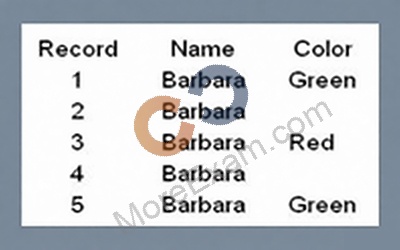
Question25: Given the following input:

Which two override options would ensure that records 1. 2, 4, and 5 would be in the same match set?

Question26: What two approaches to use when determining fields to use for blocking?

Question27: A client's data has information from several source systems combined into a single input file. The data needs to be matched within source system and all data must be retained. There is a field present in the data which identifies the source system.
Which approach would best accomplish this task?

Question28: When exporting a rule set to a .dsx file, what check box options should be selected?

Question29: Which two elements are part of a lookup table in Standardization Rules Designer?

Question30: Which data type(s) will NOT be supported by Standardization?

Question31: What is a function of rule sets in the Standardize stage?

Question32: Which acronym is also referred to as CASS?

Question33: When building a field level survivorship routine and the same business rule applies to all address columns, what is the most efficient way to do this?

Question34: You are using the Match Designer with a One-source match specification. You have attempted to configure the match specification test environment and received an error when you selected 'Update'.
What is the most likely cause of the problem.

Question35: What is the most optimized way to pass data between jobs?

Question36: In order to accomplish Word Investigation in a single QualityStage job, how many investigate stages would be required for the following fields:
PREFIX, FIRST_NAME, LAST_NAME. SUFFIX. ADDRESSJI. ADDRESS_2, ADDRESS_3, CITY, STATE.
andZIPCODE?

Question37: In addition to the QualityStage module, what product do you need to deploy a QualityStage job as a service?

Question38: In the output fields available from the Name Standardize rule set, how many MatchPrimaryWords are defined?

Question39: You decide to classify values that are often spelled or represented incorrectly in your data. What is the correct way to implement this classification?

Question40: A transaction date field has format MM-DD-YYYY. The customer wants to see how many records contain a valid month in the transaction date field.
Which mask type should be used in the Character Discrete investigation?

Question41: How does QualityStage output the correct ISO code for a record?

Question42: What two rule groups are needed for rule sets?

Question43: Customer data is being processed in a single file. Among the fields present for matching are national identity number and birth date, both of which are inconsistently populated.
Which match type should be used to match this data?

Question44: Which statement is true?

Question45: When a single file match is required where all records must be processed through every pass, what match type is required?

Question46: What will improve classifications if there are a large amount of "@" and "?" symbols in a standardization pattern report?

Question47: Which statement represents the pattern that does NOT end with a number?

Question48: What four files are part of the QualityStage rule set?

Question49: Refer to the exhibit that appears below.

You are developing an ISD reference match job. The reference data is maintained in a database and must be referenced at runtime.
You have three passes in your match specification and the input is one record at a time.
Which statement is true about the job design?

Question50: Which two steps in the QualityStage Data Quality Methodology facilitates effective matching?

Question51: When would you use the survive technique 'Most Frequent'?

Question52: A complex QualityStage job is running slowly on a two CPU server. The parallel engine configuration file contains eight nodes.
How can performance be improved?

Question53: A major international financial firm has clients in over 35 countries, including the U.S. and Japan. A requirement exists to standardize all addresses and validate the U.S. and Japanese physical addresses.
How can this be accomplished?

Question54: Which threshold is used to identify input data Strings are probably the same?

Question55: What would happen if a special character is included in the SEPLIST and not in the STRIPLIST?

Question56: If a match pass has a match cutoff weight of 10 and a clerical cutoff weight of 8. what would be the weight range for clerical records?

Question57: What are two purposes of Standardization processing?

Question58: What does the default Class Label "A" on a pattern rule in SRD describe?

Question59: Which statement is true?

Question60: You are designing a reference match that will be run on a daily basis. Where should the reference data frequencies typically be generated?

Question61: You need to create a batch delta match process for transaction records against a very large master file of existing clients.
Which QualityStage match option should be used?